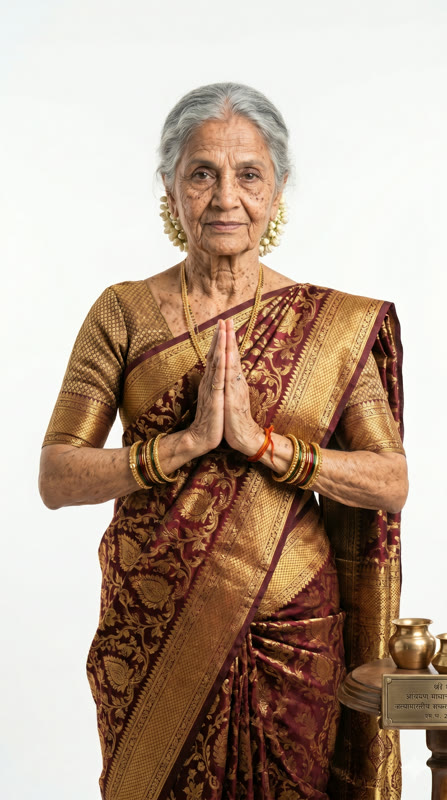
Smt. Kamla Devi Jha
52 years of practice
Mithila Nadi Jyotish · Generational family readings · Long-arc Vimshottari timing
Kamla Devi was born into the Mithila jyotish parampara in a village outside Darbhanga, where nadi reading is taught alongside the shastras from childhood. Her father began teaching her to read charts at the age of seven, and at seventeen she took her first paying client — a neighbour whose daughter's marriage had been delayed three years. Fifty-two years later, she has read for three generations of that same family, and dozens like it.
Her strongest work is long-arc timing: not *what* will happen, but *when*. She treats a chart the way a Mithila farmer treats a field — you know what has been sown, but soil and season together decide when the harvest ripens. Her clients return not for new predictions but to ask "is the time now?" — and she answers with the same Vimshottari precision she learned at her father's knee.
She reads in a mix of Hindi, Maithili, and Sanskrit, and begins every session with an hour of listening, because a chart without its life story, she says, is just arithmetic.
“People think the chart tells them what will happen. The chart tells them when — and the when is what matters most.”

Dr. Ishani Pandey
13 years of practice
Modern Parashari · Ashtakavarga & Shadbala · Career, academic & marriage timing
Ishani holds a PhD in Jyotish Shastra from Banaras Hindu University, where her dissertation on the application of ashtakavarga to contemporary career decisions was published by the department in 2019. She reads charts for a generation of clients — mostly in their late twenties to early forties — whose questions the classical texts don't literally address but whose chart signatures are the same ones Parashara described two thousand years ago.
Her focus is career transitions, academic timing, and cross-cultural marriages. She reads in a mix of Hindi, English, Sanskrit, and Gujarati, and writes a monthly essay at the intersection of classical Parashari and the questions people actually bring her: late marriage, mid-career pivots, choosing between offers, emigration timing.
She favours quantified technique over intuition. When a chart is ambivalent, she pulls the Dashamsha (D10) for career specifics, runs the shadbala numbers, and checks the ashtakavarga bindus before she gives her reading. She is part of a small generation of acharyas bringing classical jyotish into dialogue with modern life without diluting either side.
“Every generation brings the chart the same questions. The chart is old — but the questions it answers are the ones you are asking today.”
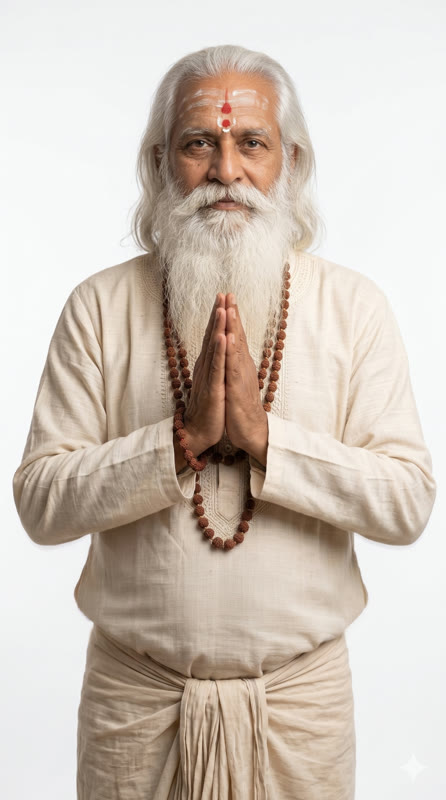
Swami Raghunath Maharaj
38 years of practice
Vaishnav Remedial Jyotish · Mantra, upasana & daana prescription · Prashna readings
Raghunath took sannyasa at thirty, leaving a settled household life in Kolkata to train under his guru in a small Vaishnav ashram outside Haridwar. For thirty-eight years he has read charts as a remedial astrologer — his work is not prediction for its own sake, but prescription. Every reading ends with a specific remedy: a mantra with its prescribed count, a fast on a particular tithi, a daana to a specific class of recipient.
His remedies come from Puranic sources — the Bhagavata, the Vishnu Purana, the Skanda Purana — and from the living Vaishnav tradition he received from his guru. He is particularly sought for Prashna (horary) readings: a single burning question, answered from the chart of the moment it was asked.
His readings are brief, rarely more than twenty minutes, and sparse in language. What he does not say is as deliberate as what he says. He refuses to predict death or to guarantee outcomes. He says only that a remedy prepares the heart to receive what the chart is already ready to give.
“Fate is fixed. Effort is yours. Remedies are the bridge — and they work only when the heart walks across.”
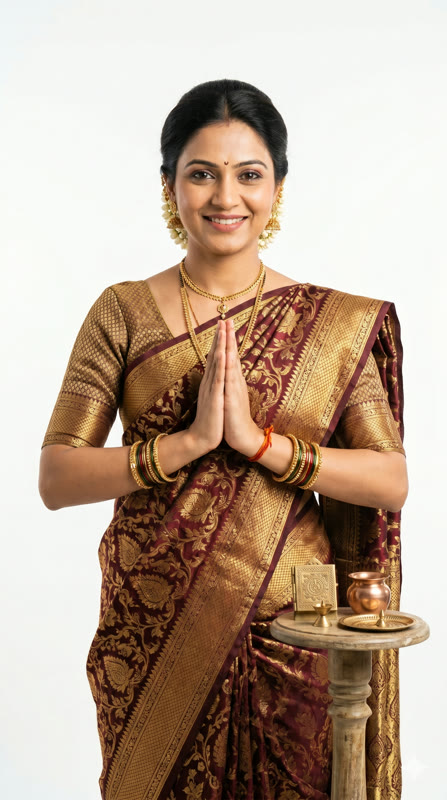
Acharya Nandini Pathak
11 years of practice
Classical Parashari · Kundli Milan & Ashtakoot matching · Everyday family guidance
Nandini grew up in a Marathi-Hindi household in Pune where her paternal grandmother read charts for the neighbourhood — weddings, naming ceremonies, pregnancies, job decisions, the ordinary questions of ordinary lives. She trained formally at the Bharatiya Vidya Bhavan, earning her Jyotish Visharad in her twenties, but her reading style came from her grandmother: plain, direct, without mystification.
Eleven years into practice, she reads mostly for families — kundli milan for engagement families before a match is finalised, chart comparisons for married couples working through difficult years, and the career and money questions people ask when life gets complicated. She is fluent in the full ashtakoot system and particularly careful with Manglik and Nadi dosha interpretations, where she sees many astrologers over-read the chart and cause unnecessary family distress.
She reads in Hindi, English, and Marathi. She does not schedule Prashna sessions, does not prescribe gemstones casually, and does not take on cases for which she does not have the time to read the chart carefully.
“A kundli is a mirror held up to your life — my job is to help you see it clearly, not to tell you what to feel about it.”